


Recetas
Spanish Paella: Recipe, history and tradition

Nov
There are dishes that make you feel at home even if you’re a thousand kilometers away. Valencian paella has that power. It doesn’t matter if you taste it in a small rural village or on a terrace facing the sea: its aroma of wood fire, that golden touch of the rice, and the sizzling sound when the socarrat begins to form transport you straight to Valencia.
And yet, behind that popular image, there’s a whole story few people really know. It didn’t originate in restaurants or tourist guides. Paella is a countryside dish, one for slow Sundays, created by people who cooked with whatever they had on hand.
A humble, rural origin
If you go back a few centuries, to the times when farmers worked the Valencian farmland, you’ll find the first hints of the dish. In those days, meals were made outdoors, using ingredients from the land and animals from the farm. Chicken and rabbit were almost a luxury, and rice—abundant thanks to the rice fields of the Albufera—became the backbone of the recipe.
Farmers cooked in a wide iron pan with handles, called paella in Valencian. That’s where the name comes from. Over time, the word stopped referring only to the utensil and also came to name the dish itself. One of those happy confusions that end up becoming part of the culture. paella. De ahí viene el nombre. Con el paso del tiempo, el término dejó de referirse solo al utensilio para dar nombre también al plato. Una de esas confusiones felices que acaban formando parte de la cultura.
Many people mistakenly call the utensil used to cook paella a paellera ; the correct name is "paella." paella.

En su origen no existía una “receta oficial”. Cada casa tenía su versión. Lo que sí estaba claro era que la paella se cocinaba para compartir, y que debía hacerse con ingredientes frescos, del entorno. Por eso, cuando alguien le pone chorizo o guisantes, a un valenciano se le escapa una mueca entre la risa y la indignación. No es cuestión de purismo, sino de respeto por una tradición que ha sobrevivido siglos sin necesidad de adornos.
The Sunday ritual
In Valencia, paella isn’t improvised. It’s planned. It starts early, almost always on a Sunday. While someone prepares the firewood, another cleans and cuts the meat. Someone else brings the rice, another the garrofó (that flat white bean that’s so characteristic), and another is in charge of the wine or beer.
Everything revolves around the fire. As soon as it’s lit, the atmosphere changes. The cook—the “paellero”—becomes the center of attention. No one dares touch the paella without their permission, but everyone comments, gives opinions, and offers advice. It’s part of the game.
When the sofrito starts to smell and the oil crackles, there’s no turning back. Conversation softens. Everyone glances at the fire, waiting for that moment when the rice begins to absorb the broth and the paella becomes something more than food.

Authentic ingredients (serves 4)
The original Valencian paella recipe isn’t up for debate. According to the Denomination of Origin guidelines, this is what it contains, no more and no less:
- 400 grams of bomba rice
- Half a chicken chopped into pieces
- Half rabbit chopped into pieces
- 150g of flat green beans (ferraura)
- 100g of garrofó
- 1 ripe grated tomato
- 1 teaspoon of sweet paprika
- A few saffron threads or coloring
- Extra virgin olive oil
- Water (about two and a half times the amount of rice)
- Salt to taste
- Fresh rosemary (optional)
No seafood, no chorizo, no onion. The magic lies in simplicity and in the perfect balance of ingredients.
How to prepare it, step by step
Cooking paella isn’t just following a list of steps. It’s understanding what happens at each one. But if it has to be put into writing, it would go more or less like this:
Prepare the fire
If you can use orange tree wood, even better. It produces stable embers and a gentle aroma. If not, a good gas burner works too, but make sure the heat is evenly distributed.
Add the oil, level the paella pan, and wait until it’s hot.
Brown the meat
Add the chicken and rabbit, and let them brown slowly. This step cannot be rushed. The meat must seal well and become almost crispy on the outside. That browning is the foundation of the flavor. When ready, add the green beans and garrofó. Stir with the spatula and let everything blend with the oil.
Sofrito and broth
Make a space in the center and add the grated tomato. Cook until the water evaporates and the sofrito thickens. Add the paprika and stir for just a few seconds, right before adding the water. The amount of water matters: two and a half parts for every part of rice. And then… patience. Let it boil for at least half an hour. This step allows the meat to release all its flavor and gives the broth body.
The rice
When the broth tastes rich, the decisive moment arrives. Add the rice in the shape of a cross, spread it carefully, and… don’t stir it again! The rice has to stay still and cook where it falls. Add the saffron threads or coloring and let it boil strongly for the first 10 minutes. Then lower the heat a bit and let it cook another 8 to 10 minutes.
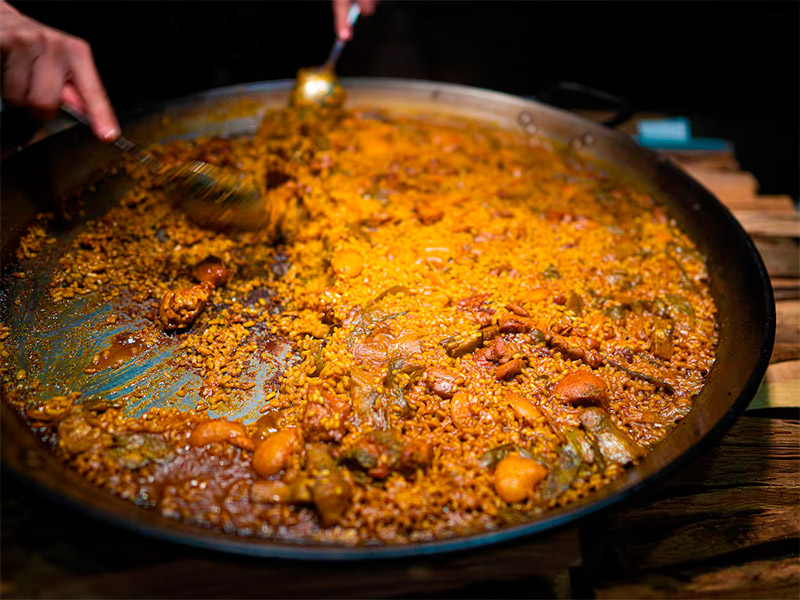
The socarrat
That crispy golden bottom is the pride of any paella cook. When the broth has almost evaporated, raise the heat slightly and listen. If you hear a light crackling, you’re on the right track. If it smells burnt, turn it off quickly.
Rest
Once off the heat, let the paella rest for a few minutes covered with a cloth. Don’t rush. The rice needs a moment to settle. Then bring it to the table and serve it without plates, directly from the pan. In Valencia, each person eats from their “section” and no one invades another’s. Tradition is tradition.
Tips that aren't in the books
- Paella isn’t stirred, it’s observed.
- If the water evaporates too quickly, add a little more, but make sure it’s hot.
- Never cover it while it boils.
- Don’t overuse coloring. Bright yellow doesn’t improve flavor.
- And above all, enjoy the process. The best paella isn’t the perfect one, but the one that’s remembered.
A dish that transcends borders
Today, paella is cooked all over the world. Every country, every cook, every family has its own version. Some respect the tradition; others experiment with exotic ingredients. And although Valencians sometimes see this with a mix of humor and resignation, the truth is that thanks to those variations, the word “paella” has reached places where no one had ever heard of the Albufera.
But if you want to try the real one, the traditional one, you have to go to the source. To the villages where Sundays smell like firewood and rice, where recipes are passed from grandparents to grandchildren without the need for books or exact measurements. There you’ll understand that paella isn’t just food: it’s memory.
Conclusion: More than a recipe, a way of life
Cooking paella is an act of community. It’s not made for one person, nor is it eaten in a hurry. It’s an excuse to gather, to laugh, to tell stories while the rice slowly turns golden.
Every spoonful carries the flavor of togetherness, of something that can’t be bought or rushed. And maybe that’s why Valencian paella remains alive—because beyond the technique and the ingredients, what really matters is the spirit in which it’s cooked.
So next time you make one, take your time. Invite your people, light the fire, and let time do its part. Because at that moment, without even realizing it, you’ll be participating in a tradition that has been bringing people together around a paella pan for centuries.
